
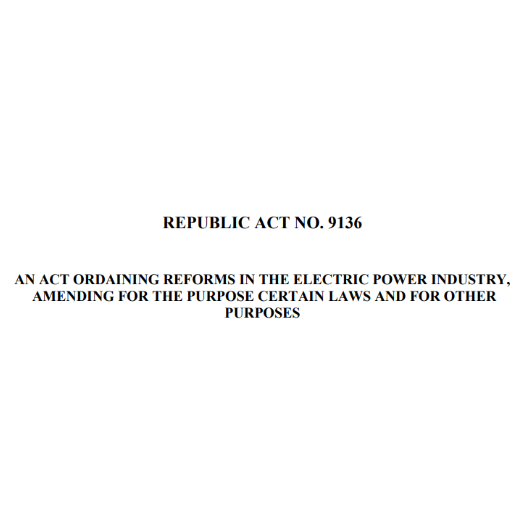
The Electric Power Industry Reform Act (EPIRA) of 2001 is a landmark legislation in the Philippines that aimed to restructure and privatize the country’s power sector. Enacted to address inefficiencies, promote competition, and ensure reliable and affordable electricity supply, EPIRA introduced significant changes to the industry landscape.
Key Features of EPIRA:
- Deregulation and Privatization: EPIRA sought to break the monopoly of the National Power Corporation (NPC) and promote competition by privatizing generation assets. This led to the establishment of the Wholesale Electricity Spot Market (WESM), allowing generators to sell electricity directly to distribution utilities and large consumers.
- Creation of Regulatory Bodies: The law created regulatory bodies such as the Energy Regulatory Commission (ERC) to oversee the power sector’s activities, ensure fair competition, and protect consumer interests. The ERC sets the rules and guidelines for market participants, approves power rates, and resolves disputes.
- Divestment of Assets: EPIRA mandated the sale of NPC’s generation assets to private investors through a transparent and competitive bidding process. This divestment aimed to reduce government intervention in the power sector and encourage private sector participation.
- Promotion of Renewable Energy: The law incentivized the development of renewable energy sources by providing fiscal and non-fiscal incentives, such as tax exemptions and priority dispatch for renewable energy projects. This move aimed to diversify the country’s energy mix and reduce reliance on fossil fuels.
- Consumer Protection Measures: EPIRA included provisions to protect consumers, such as the Universal Charge (UC) fund, which subsidizes missionary electrification and lifeline rates for low-income households. The law also mandated the establishment of the Customer Complaints Office within the ERC to address consumer grievances.
Impact of EPIRA:
- Increased Investments: EPIRA attracted private investments in the power sector, leading to the construction of new power plants and improved infrastructure. This influx of capital contributed to the modernization of the industry and enhanced its efficiency.
- Lower Electricity Rates: Competition among power generators in the wholesale market helped drive down electricity prices, benefiting consumers and businesses. However, challenges such as market manipulation and price volatility have also emerged, prompting regulatory interventions to stabilize prices.
- Renewable Energy Development: EPIRA’s incentives spurred investments in renewable energy projects, particularly in wind, solar, and hydroelectric power. The Philippines has seen significant growth in renewable energy capacity, reducing carbon emissions and enhancing energy security.
- Challenges and Criticisms: Despite its achievements, EPIRA has faced criticism for its failure to fully address issues such as power sector corruption, market manipulation, and lack of competition in some areas. Concerns also remain regarding the vulnerability of consumers to price fluctuations and the dominance of a few players in the market.
Key Players of EPIRA:
Key players in the implementation and regulation of the Electric Power Industry Reform Act (EPIRA) in the Philippines include:
Department of Energy (DOE): Responsible for crafting policies, regulations, and programs for the development, exploration, and utilization of energy resources, including the implementation of EPIRA.
Energy Regulatory Commission (ERC): Established to regulate the operations of the power sector, including setting rates, ensuring fair competition, and resolving disputes among market participants.
National Power Corporation (NPC): Historically the state-owned monopoly responsible for power generation, transmission, and distribution in the Philippines. EPIRA mandated the privatization and restructuring of NPC’s generation assets to promote competition.
Distribution Utilities (DUs): Companies responsible for distributing electricity to end-users within their respective franchise areas. EPIRA encouraged competition among DUs and facilitated open access to the transmission and distribution systems.
Generation Companies (GenCos): Private entities engaged in the generation of electricity. EPIRA aimed to promote competition by privatizing NPC’s generation assets and allowing GenCos to participate in the wholesale electricity market.
Transmission Company (TransCo and its Concessionaire): Initially, the National Transmission Corporation (TransCo) was responsible for the overall transmission of electricity. It was then eventually be operated and maintained by a concessionaire. The ownership shall remain with TransCo.
Independent Power Producers (IPPs): Private companies that own and operate power plants under contracts with the government or DUs. EPIRA sought to promote transparency and fair competition in the contracting process for IPPs.
Renewable Energy Developers: Entities engaged in the development, construction, and operation of renewable energy projects, such as wind, solar, hydroelectric, and biomass power plants. EPIRA provided incentives to promote the development of renewable energy sources and reduce reliance on fossil fuels.
These key players, along with various stakeholders including consumers, investors, and industry associations, play crucial roles in shaping the implementation and impact of EPIRA on the Philippine power sector.
Conclusion:
The Electric Power Industry Reform Act (EPIRA) has transformed the Philippine power sector, fostering competition, attracting investments, and promoting sustainable energy development. While the law has achieved significant milestones, continuous review and reforms are necessary to address emerging challenges and ensure the long-term sustainability and affordability of electricity supply in the country.
Author’s Opinion:
In my opinion, the Electric Power Industry Reform Act (EPIRA) in the Philippines has had mixed effectiveness. On one hand, it is undeniable that EPIRA has spurred private investments in the power sector and led to the development of renewable energy projects. This has diversified our energy sources and contributed to lowering electricity rates in some instances, which undoubtedly benefits consumers like me.
However, there are glaring challenges that cannot be ignored. Market manipulation and the lack of effective competition have led to occasional spikes in electricity prices, leaving consumers vulnerable to fluctuations. Additionally, despite the intention to promote competition, there are still regions where choices for consumers remain limited, potentially fostering monopolistic behavior among some players.
While EPIRA has made strides, it is clear that reforms are needed to address these shortcomings. Strengthening market oversight, enhancing transparency, and bolstering consumer protection measures should be prioritized. We must also keep a vigilant eye on long-term sustainability, especially in the face of evolving market dynamics and technological advancements.
In essence, while EPIRA has laid down a framework for reforming the power sector, its effectiveness ultimately hinges on our ability to adapt, refine, and implement policies that truly serve the interests of all stakeholders, ensuring a reliable, affordable, and sustainable energy future for the Philippines.
Feel free to put down your comments if you agree/disagree with me.
 KASHIKOI
Leave a comment